
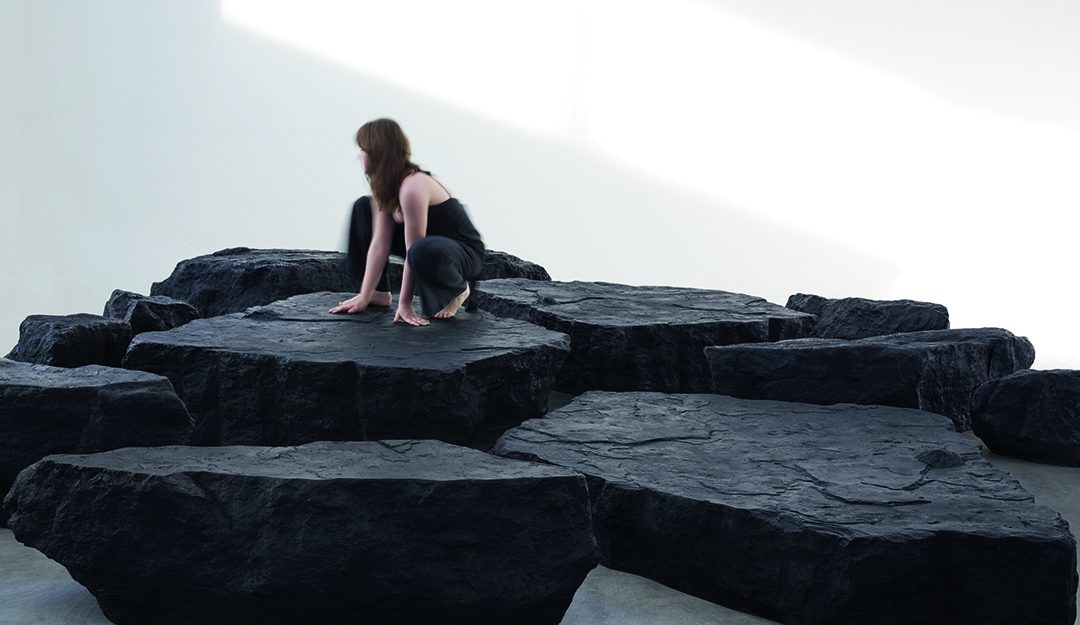
Verter Turroni – 1965 – is an Italian artist and designer, co-founder with Emanuela Ravelli of imperfettolab.
The verb “worked” (in its past-participle form) has been placed in inverted commas precisely to highlight more forcefully this artist's industriousness, his indispensable manual skill, his full commitment to the act of creation which, in the potential of matter, finds not inertia but a life that springs forth between acting and not acting. A primal movement, this, which is also a struggle for control of the process, be it an oxidation.
Marco Bazzini, in “Il risveglio dell'angelo” (critical essay).
How did your passion for art begin, and how did you decide to make it the centre of your life, turning it into a profession?
I believe that what fuelled my passion for art and for my work was, first of all, the atmosphere of the house where I was born and grew up. My father painted, and painting was a natural presence, together with the paintings and art books that inhabited the rooms as necessary things. The fact that my brother also became an artist is, for me, further confirmation of that family condition: it is not something we chose, but a language that grew on us, shared without need for explanation.
Art became a profession the moment I recognised that this research was not separate from life, but my most precise way of moving through it.
How do you transform an idea or a “simple” sketch on paper into a sculptural work?
For me the sketch is never preparatory. It is not a plan, nor a compulsory step towards sculpture. It is rather a gesture of pause, a form of light concentration. I work constantly with my eyes and hands; form is built through making, correcting, looking again. The drawings hold an experience of form, a passage of the gaze.
What role does intuition play in how you choose, combine and bring materials into dialogue in your works?
For me intuition is central: it is a form of silent intelligence, built over time, after more than thirty years of work. When I speak of “intuition” I mean the ability to recognise a possibility immediately. First I observe, at length, and then my hands translate what my eyes have already begun to understand. It does not come from nothing: it comes from the habit of looking, from constant making, from having learned to feel how far a material can go and where instead it resists.
Your creations evoke organic forms and precarious balances. What inspires you most?
I am inspired by what has passed through time without losing its mystery. Archaeology and history have taught me to read forms as traces: fragments that carry a use, a ritual, a stratification. My works are born there, at the point where an artefact and an organism seem to speak the same language: that of matter that resists, changes and keeps on telling its story.
When you start a piece, do you set out to create a usable work of art, or do you create a beautiful form and then think about its use?
“As a designer I start from an idea of use and context, with the need for the object to be recognised and desired. Compromise is part of the craft: I don't experience it as a sacrifice, but as an intelligent negotiation with reality. I never describe one of my design projects as a work of art.
Design remains a territory with its own rules, a place where form must find a way to inhabit and be inhabited, not just to assert itself.
When I work as an artist, I don't seek compromise; expression is free, it doesn't have to please, it doesn't have to function. They are two different but communicating attitudes: the designer carries the artist within, and the artist keeps the designer's rigour alive. It is within this ambivalence that I manage to move without betraying either side of myself”.
As a designer, what challenges do you face in making each object unique for collectors and interior designers?
“The main challenge is keeping uniqueness alive without turning it into a stylistic device: my collection exceeds ninety pieces, and every new object must add something, without repeating itself and without betraying a language built over time.
When I started, in 1997, collectible design in the world of furniture and interiors was not a recognised path as it is today. The collection was able to grow thanks to far-sighted collectors and interior designers who believed in me. The challenge is to remain radical and independent, yet able to engage with those who choose our pieces: listening to the context, without losing the direction of the research”.
Published in OnlyONE Magazine #6
Further reading